
 Program
 YouTube
 Instagram
 Facebook
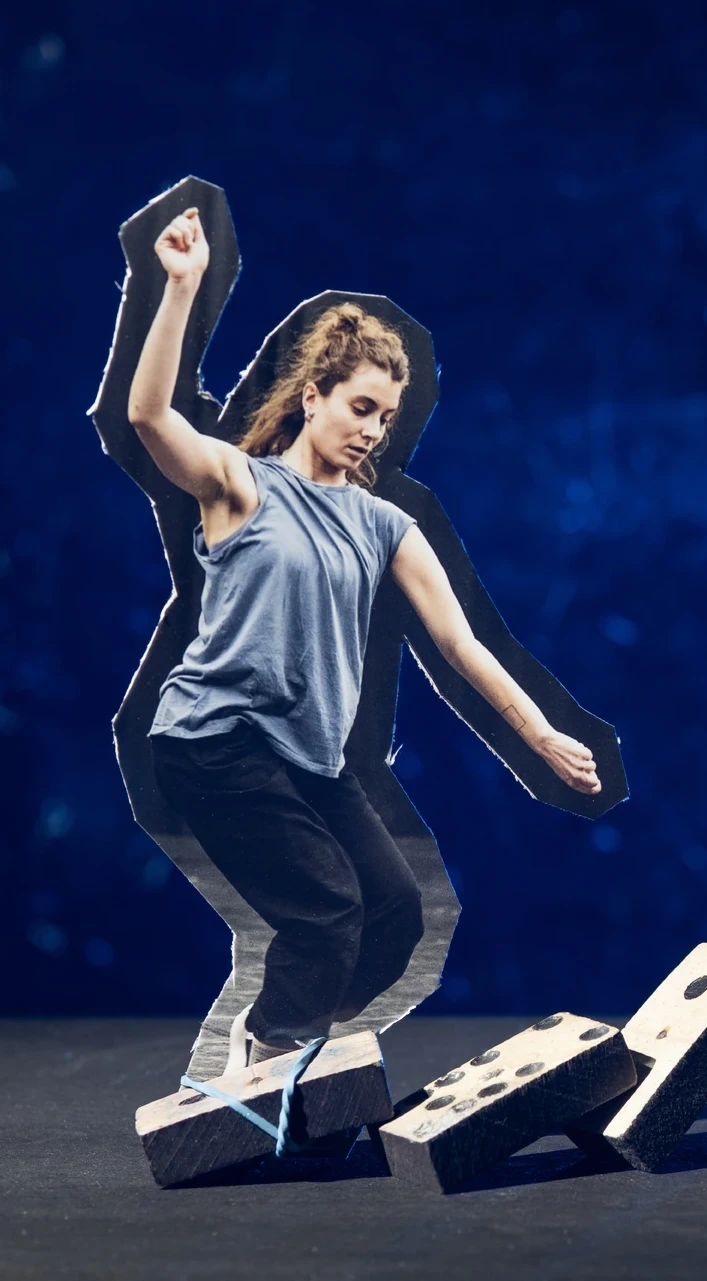
The dance of the DFDC is just as closely linked to classical dance as it is to other developments in contemporary dance history. The double bill “Byways” combines a piece by Ioannis Mandafounis, in which he delves into dance history, and a new work by Rosalind Crisp, who is internationally recognised for the way she breaks with the conventions of dance performance.
“Eins vor, zwei zurück”, Ionnis Mandafounis
As much as Ioannis Mandafounis is influenced by the innovations that were made in dance improvisation in the second half of the 20th century, his artistic journey is also that of a ballet dancer. To pay tribute to this double heritage he creates a new piece for a small cast that contrasts classical dance technique with the development of improvisational dance and his own method of live-choreography. Two dancers from the ensemble will encounter Jón Vallejo from the Semperoper Dresden. This is a deep dive both into dance history and into the biography of a dancer. The passion, the grit, the endurance, glamour, doubts, triumphs and injuries – it’s all fiction and it’s all true.
“Seen Unseen”, Rosalind Crisp
Rosalind Crisp's artistic passion is in using compositional tools to ‘forget’ movements and reveal instead how they can be forever reforming themselves when freed from set patterns and meanings. Her practice works with the constant changingness that relates to the reality of our material bodies - and that reflects, more and more starkly, the world that we are ‘undoing’. Her compositional tools invite dancers to absorb, recreate and transmit this continual changingness. She will engage the dancers of DFDC not with the psychology of what they experience, but with the corporeality of it.
As one principle to enable that vulnerability the dancers will inhabit the transitions where something is not yet one thing nor another, while drawing the audience's attention to how movement is forming, rather than to the moves thereby produced.In this practice rupture is as valid and important as flow. The work is presented in a setting of proximity where the audience can move and shift their own bodies throughout the space. Pianist and composer Frédéric Blondy will improvise live, adding his similarly visceral treatment of the piano to the dance.
Biographies
Rosalind Crisp is a choreographer and dancer based in Orbost, Australia. In 1996, she founded the Omeo Dance Studio in Sydney, which was a hub for the experimental dance scene for ten years. In 2003, she was invited by Carolyn Carlson to become the first associate artist at the Atelier de Paris, where she created ensemble works and international collaborations from 2004 to 2014. Crisp has created over 25 works, performed worldwide, and teaches internationally. Her work explores dance as live composition and understands dancers as artists. She is a Chevalier des Arts et des Lettres, an honorary member of the University of Melbourne-VCA, and received the Creative Australia Award (Dance) in 2025.
Ioannis Mandafounis was born in Athens and studied dance at the Paris Conservatory. He has danced with the Gothenburg Opera Ballet, Nederlands Dans Theater II, and The Forsythe Company, among others. He has been working as a choreographer since 2004, became a member of the Frankfurt collective mamaza in 2009, and simultaneously ran his own company in Switzerland. He has created works for numerous international companies and has performed worldwide. Mandafounis was honored by the Greek Ministry of Culture in 2002, received the Swiss Culture Prize in 2015, and was nominated for the DER FAUST theater prize in 2024 for “À la carte.” His work is based on a participatory choreographic methodology.
Frédérik Blondy is a pianist, organist, composer, and improviser with an organic, exploratory approach to sound. He works at the intersection of contemporary music, improvisation, avant-garde and free jazz, as well as electronic and electroacoustic music, and has been active in groups such as Hubbub and Ethos. He has been performing internationally for over 25 years, has released more than 25 recordings, and has composed around 20 works ranging from solo to orchestral. Blondy works interdisciplinarily with dance, video, and film. In 2011, he founded the Orchestra of New Musical Creation, Experimentation, and Improvisation (Onceim), of which he is the artistic director and conductor.
Cast & Credits
“Eins vor, zwei zurück”
| Choreography | Ioannis Mandafounis |
| Dance | Emanuele Co', Emanuele Piras, Simon Voitoux Puigrenier and Jón Vallejo, Erster Solist des Semperoper Ballett as guest |
| Choreographic Assistance | Pauline Huguet, Smaralia Karakosta |
| Dramaturgy | Philipp Scholtysik |
“Seen Unseen”
| Choreography | Rosalind Crisp |
| Dance | Sophie Borney, Thomas Bradley, Lander Casier, Audrey Demurs, Nastia Ivanova, Marina Kladi, Yan Leiva, Antonin Mélon, Solène Schnüriger, Ichiro Sugae, Ashley Alexandra Wright, Samuel Young-Wright |
| Composition, Piano | Frédéric Blondy |
| Stage Design | Rosalind Crisp |
| Costume | Dorothee Merg |
| Dramaturgy | Philipp Scholtysik |
Funding
In co-production with the Semperoper Ballett.


The Dresden Frankfurt Dance Company is funded by the City of Dresden and the Free State of Saxony as well as the City of Frankfurt am Main and the State of Hesse. Company-in-Residence at HELLERAU - European Centre for the Arts Dresden and at the Bockenheimer Depot in Frankfurt am Main.