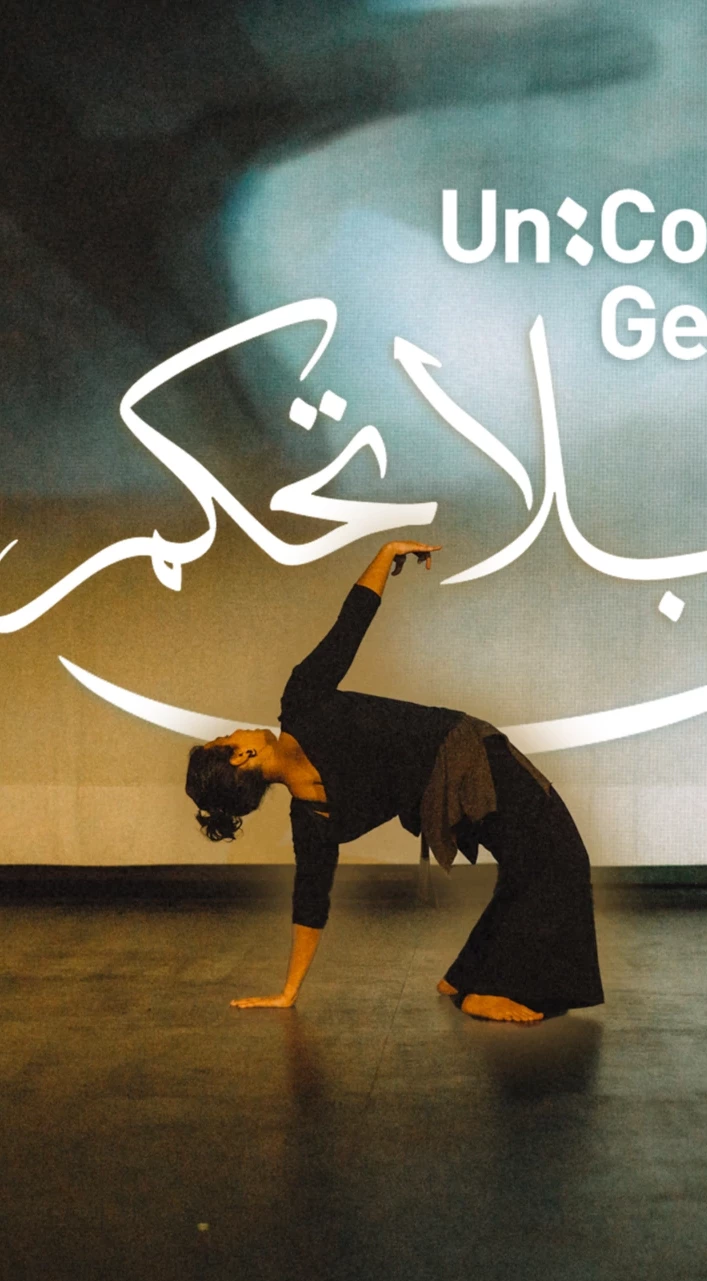
The program “Un|Controlled Gestures” aims at supporting choreographic creations within contemporary dance practices which centre on notions of body politics and poetics, intimate and collective memories that go beyond the known and written. For its 4th edition, choreographers from Egypt, Jordan, Lebanon, Syria and Tunisia were selected. The artists get the chance to develop their choreographic creations during two residencies in Cairo and Dresden/Berlin as well as benefitting from mentorship and a production grant.
“Un|controlled Gestures - 4th Edition” is an initiative of the Goethe-Institutes in North Africa and the Middle Eastin cooperation with HAU Hebbel am Ufer Berlin and HELLERAU – European Centre for the Arts (Dresden), curated by Nedjma Hadj Benchelabi.
Artists
Ahmed Ben Abid is a Tunisian multidisciplinary artist working at the intersection of dance, sound, and social activism. His work explores migration, identity, and collective memory. His debut piece “Unwell” (2023) stages two characters grappling with isolation and societal corruption. His new project “Unknown Sea” examines migration, resilience, and the youth’s struggle with disillusionment and transformation in post-revolution Tunisia. Ben Abid contributes to international projects and is a member of Theatre Building, a global performance-technology collective.
Christophe Al Haber is a multidisciplinary artist working across photography, contemporary dance, and live performance. Trained in physical theatre, his work is rooted in movement and shaped by personal experience. Through body, image, and space, Christophe explores themes of identity, connection, and transformation. His practice is a continuous search for meaning, using movement as a way to relate to the world around him.
Dana Amer grew up in a Syrian-Ukrainian family and trained as a rhythmic gymnast from age six, later joining the Syrian national team. At age eleven, she began dancing ballet which sparked her love for dance. After retiring from gymnastics, Dana embraced contemporary dance when her family moved to Beirut, Lebanon, performing with leading companies including Beirut Contemporary Ballet and Sima Dance Company. In 2023 and 2024, Dana did a one-year intensive program in Madrid. Today, she continues to develop her choreographic voice and unique movement vocabulary.
Emran Alamareen, also known as Bboy Mowgli, is a Bedouin Jordanian dancer from Petra, skilled in both breakdancing and contemporary dance. Starting at age 12, he has performed across the Middle East and Europe, representing Jordan in festivals like On Marche (Morocco) and Alma Alter Ego (Bulgaria). Emran is largely self-taught, with additional training through workshops in contemporary dance, hip-hop, contact improvisation, folk, and modern dance - earning wide recognition in the local and international dance scene.
Hadir Nached is a multidisciplinary artist working across visual arts, sculpture, dance, performance and discovering her passion currently in Social Circus. Her practice explores the relationship between the body and the public sphere. Often thought-provoking, her work engages with social issues and unfolds in public and site-specific spaces. She has performed in collective works at festivals such as CDN, Theater is a Must, BIPOD, Nassim El Raqs, and D-CAF, and took part in the Silsilah Dance Program’s final piece, “Falling”. Her solo performances include “A Disturbing Wait” and “EX-OTIC”.
Moayed El Ghazouani is a Tunisian performer and physical theatre maker whose work blends dance, theatre, and sound into multidisciplinary aesthetic forms. His practice transcends these categorizations, driven by a desire to speak truth. Trained in theatre and movement, he has participated in diverse performance projects across Tunisia, Denmark, and Italy, while simultaneously pursuing theoretical research in cultural studies. His work explores themes of transformation, survival, and the politics of visibility. His recent piece ”Rouheb” won Best Scenography in the Creative Seasons program by the Tunisian National Theatre in 2023.
Momen Nabil is an Egyptian Architect, ex-gymnastics athlete, contemporary dancer, co-founder of non-studio, and a master degree holder in ephemeral architecture and temporary space design from Elisava, Barcelona in 2021. Momen is a gradute of Cairo Contemporary Dance Center. His experience continues to expand as a creative director. He aspires to find new ways to use architecture and performance for visual storytelling.
Curator
Nedjma Hadj Benchelabi is a dramaturge and curator, born in Algiers and based in Brussels. Through her artistic and curatorial work, she cultivates exchanges between Europe and the SWANA region while supporting emerging artists and interdisciplinary collaboration. She has collaborated with major institutions such as the Brussels City Theatre (KVS) and Les Halles de Schaerbeek, where she worked as performing and literature curator. In 2012, she curated Daba Maroc, a season dedicated to Moroccan contemporary arts. Since 2014, she has been Associate Curator of the international contemporary dance festival On Marche in Marrakech, where she also coordinated the Dance Biennial of Africa (2021). Between 2016 and 2018, she collaborated with Cairo’s multidisciplinary festival D-CAF as curator of the Arab Arts Focus. She has also curated festivals and programs including Tashweesh (Cairo and Brussels, 2017–2018), Un|Controlled Gestures (since 2019), and Halaqat (2022), supported by the Goethe-Institut. Since 2019, she has been the curator of the Mahmoud Darwish Legacy Program, a multidisciplinary platform from Brussels and beyond. Recently, she also teaches in the Master in Dance & Choreographic Practices, where she shares her expertise in contemporary practices. Across all her projects, she remains committed to supporting young artists and fostering spaces of exchange. Through her interdisciplinary explorations, Nedjma seeks to cultivate artistic languages that move beyond conventional narratives—layered and poetic forms of expression that embrace fragility as a mode of resilience and choreograph intimate and collective memories into new body languages.
More information about the residency program